What is thermal spray?
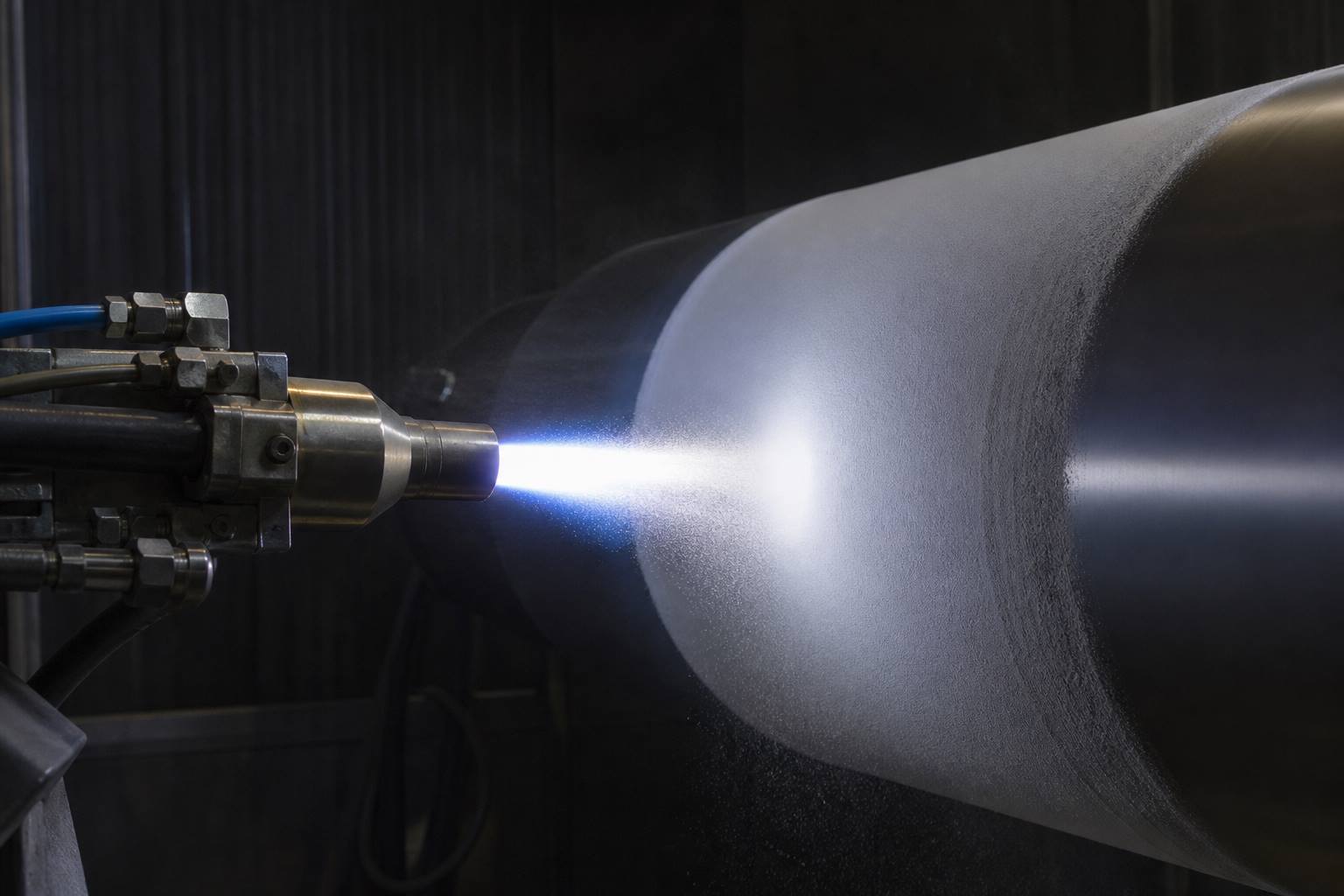
Thermal spray is a family of processes that heat a powder or wire and throw it at a grit-blasted surface fast enough that the droplets stick and stack into a coating. It is not a paint, and it is not a weld, though some cousins on this site sit closer to welding than others.
The part usually arrives worn undersize or new and underspecified for the duty. The shop masks what must stay clean, blasts to a specified profile, preheats if the procedure says so, and lays metal or ceramic until thickness is there for grind stock. Bond is mechanical for most spray work: the splat locks into the peaks of the blast. That is why a greasy journal and a pretty-but-shallow blast fail in the field even if the coating looks thick on the bench.
Choice of process is a materials and geometry problem, not a brochure problem. HVOF drives carbide and alloy particles hard enough to make a dense, hard land for sliding wear. Plasma reaches temperatures that melt ceramics and stubborn alloys for heat and chemical barriers. Electric wire arc eats pounds of steel or bronze when a large diameter must come back to size before the weekend. Combustion wire still earns its keep on zinc, aluminum, and selected rebuilds. When the drawing wants a metallurgical bond and a tough edge, the job leaves spray and goes to laser cladding.
Geometry splits the booth further. An outside diameter on a lathe fixture is a different dance from an inside diameter gun working a bore that you can barely see. After spray, the coating is almost never the finished surface. CNC taper grinding and diamond grinding of carbide put the diameter on the print. Super finishing knocks the peaks down for seals and ink. Old coatings come off by waterjet more often than by a wheel that chews the substrate. Fatigue-sensitive steel may see shot peening. Cracks get a look under fluorescent penetrant before anyone stamps the traveler.
St. Louis Metallizing did not invent the physics. The shop did learn, on real millwrights’ parts, which combination of gun, powder, grind, and inspection keeps a component in power, printing, aerospace, or heavy equipment without turning the rebuild into a science fair. If the part is new production, the same discipline shows up on OEM components. Questions that are really about the company, not the gun, belong on Our Company. To put a job in the queue, use contact.
People still confuse thermal spray with hard chrome in conversations that start with “can you plate this.” Chrome has its place; this building is a spray and grind house. The conversation that helps is wear mode, temperature, mating material, and how much stock is left in the base metal. Bring those four and the process page writes itself.